Ozium vs Meguiar’s: Which Smoke Odor Killer Wins in 2026?
When your car smells like an ashtray, a standard hanging freshener is a Band-Aid on a broken bone. Smoke clings to headliners, vent tubing, carpets, and seat foam, and masking it with vanilla only makes it worse. Two products built specifically to fight that kind of set-in odor are Ozium and Meguiar’s Whole Car Air Re-Fresher — and this Ozium vs Meguiars comparison breaks down how each one works, so you can pick the right weapon for your car.
Both brands have earned spots in our top 10 car air freshener brands roundup for very different reasons: Ozium is a legendary air sanitizer that has been killing smoke smells for over 50 years, while Meguiar’s Re-Fresher is a one-time fogging treatment that resets a whole car in a single 15-minute session. They are not really the same kind of product — which is exactly why comparing them is useful when weighing Ozium vs Meguiars head to head.
Ozium vs Meguiars: Quick Answer
Ozium is the better choice for ongoing smoke odor control — it is an EPA-registered air sanitizer in spray or gel form that you use repeatedly to eliminate cigarette and other odors. Meguiar’s Whole Car Air Re-Fresher is the better one-time reset — a single-use fogging can that circulates mist through your ventilation system to reach ductwork and headliners that sprays cannot. Pick Ozium for maintenance, Meguiar’s for a deep reset after cleaning.
How Ozium Kills Odors
Ozium is not a freshener in the usual sense — it is a glycol-ized air sanitizer built around propylene glycol and triethylene glycol. When sprayed into the air, the fine mist binds to odor-causing molecules and airborne bacteria rather than simply covering them with fragrance. The product was originally developed for hospital and medical use, and it has been on the market for more than 50 years. Its EPA-registered label carries the claims “Reduces Airborne Bacteria” and “Removes Smoke,” which is why it remains the go-to recommendation in the Ozium vs Meguiars debate for smokers’ cars.
Ozium comes in two main formats. The spray is available in 0.8 oz, 3.5 oz, and 8 oz cans, plus a 2 oz Single Shot designed for one-time vehicle treatments. The gel is a 4.5 oz canister you crack open and leave under a seat for continuous passive odor control. Scents include Original, That New Car Smell, Carbon Black, Outdoor Essence, Vanilla, Country Fresh, and Citrus. A common myth to correct: despite the name, Ozium does not produce ozone — it sanitizes the air with glycol vapor.
Using the spray for a smoky car is straightforward: crack the windows slightly, spray a short burst toward the center of the cabin (or into the air intake vents), step out, and let the mist settle for several minutes. The 8 oz can lasts many treatments, making it economical as a maintenance product in the Ozium vs Meguiars matchup. Our full Ozium air freshener review covers every format and scent in detail.
One caution straight from the label: avoid inhaling the mist, keep it off painted surfaces, do not store it above 130°F, and note that the spray is flammable. Always let the car air out briefly before driving.
How the Meguiar’s Re-Fresher Mist Works
Meguiar’s Whole Car Air Re-Fresher Odor Eliminator Mist is a single-use 2 oz (57 g) aerosol can with a locking trigger that turns it into a hands-free fogger. The original New Car scent (part #G16402) is the classic; later variants include Summer Breeze, Citrus Grove, Black Chrome, Fiji Sunset, and Stargazer. Each can treats exactly one vehicle, one time.
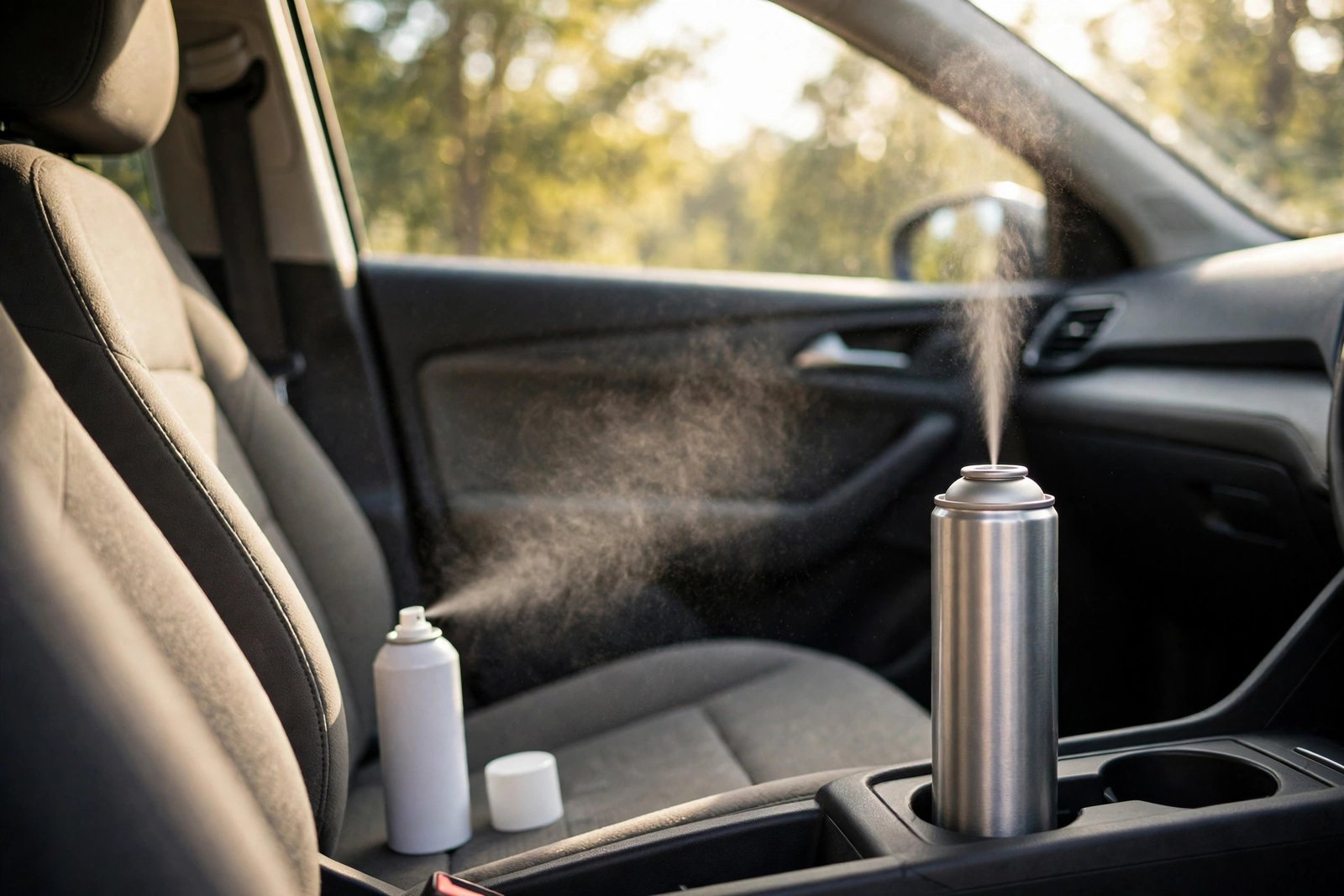
The mechanism is what makes it different from everything else in this Ozium vs Meguiars matchup. With the engine running, the fan on high, and the system set to recirculate, you place the can upright in the center of the car (typically the floor between the front and back seats) and let it empty itself over about 15 minutes. The fine mist gets drawn into the intake and pushed through every duct and vent while settling over seats, carpets, and the headliner — the places where stale smells actually live.
Meguiar’s says its Re-Fresher technology “permanently removes existing bad odors through chemical bonding at a molecular level” rather than covering them with perfume. That is the manufacturer’s claim, and it is the right lens for judging the product in the Ozium vs Meguiars comparison: it is sold as an odor eliminator first and a fragrance second.
The official directions from Meguiar’s technical bulletin are specific: the car must be unoccupied (no people, pets, or plants), vacuum and clean soiled upholstery first, park in the shade in a well-ventilated area, run cold recirculated air on high with windows closed, activate the can with the nozzle facing away from you until the actuator locks, then close the doors for 15 minutes. Afterward, open all doors and let the cabin air out for 10–15 minutes before driving. Our Meguiars Whole Car Air Refresher review walks through the full process step by step.
Important caveat from the same bulletin: remove the odor source first. No mist can fix a moldy trunk liner you never cleaned — the Re-Fresher is the finishing move after cleanup, not a substitute for it. It is also a flammable aerosol (the technical data sheet carries a Fire rating of 4), so keep it away from ignition sources.
Ozium vs Meguiars Side by Side
Here is how the two products stack up head to head in this Ozium vs Meguiars comparison.
| Feature | Ozium | Meguiar’s Whole Car Air Re-Fresher |
|---|---|---|
| What it is | EPA-registered air sanitizer (spray or gel) | Single-use aerosol fogger |
| How it attacks odor | Glycol mist binds odor molecules and airborne bacteria | Mist circulates through the ventilation system; manufacturer claims chemical bonding at the molecular level |
| Reaches inside ductwork | Only if sprayed at the intake vents | Yes — designed to flow through the entire HVAC system |
| Usage pattern | Repeat use (spray as needed; gel runs continuously) | One-time 15-minute treatment |
| Ongoing scent | Yes, while the product is in use | Light residual fragrance for weeks; odor reset is the point |
| Best for | Regular smokers, daily maintenance, spot treatments | Deep one-time reset after a thorough cleaning |
| Effort | A few seconds per treatment | About 30 minutes total, most of it waiting |
| Who it suits | Someone keeping a smoker’s car under control week to week | Someone who just bought or just detailed a smelly car |
Ozium vs Meguiars: Round-by-Round Winner
Round 1: Smoke Odor Elimination
Both products genuinely eliminate rather than mask odors — the shared strength of this Ozium vs Meguiars matchup. Ozium’s glycol formula is purpose-built for smoke: its EPA label explicitly claims smoke removal, and 50+ years of reported use in smokers’ cars back it up. The Meguiar’s Re-Fresher reaches deeper physically but is a one-shot event. For a car that is smoked in regularly, Ozium’s repeatable treatments win. Winner: Ozium.
Round 2: Whole-Car Reach
This is where the formats diverge in the Ozium vs Meguiars contest. Ozium spray settles where you aim it; getting it deep into HVAC ductwork requires deliberately spraying at the intake. The Re-Fresher was engineered for exactly this: the recirculation fan pulls its mist through every duct, vent, and hard-to-reach panel gap. For smells hiding behind the dashboard, Meguiar’s wins. Winner: Meguiar’s.
Round 3: Ease of Use
Ozium takes seconds — a quick spray and a few minutes of settling. The Re-Fresher demands a 30-minute ritual: vacuum, park in shade, set the climate, trigger the can, wait 15 minutes, air out for 10–15 more. It is not hard, but it is a project. Winner: Ozium.
Round 4: Ongoing Freshness
Once the Re-Fresher’s session is over, only a light fragrance remains for a few weeks — and its job is done, a key point in the Ozium vs Meguiars debate for ongoing freshness. Ozium spray or gel keeps working as long as you keep using it, which matters for cars that keep getting smoky. Note the gel is the true “set and forget” option here. Winner: Ozium.
Round 5: Value
The 8 oz Ozium spray delivers dozens of treatments; the gel runs for weeks from a single 4.5 oz can. The Re-Fresher’s single can covers one session for one car. As pure per-dollar odor-fighting capacity, Ozium stretches further — though for a single deep reset the Re-Fresher is stillill far cheaper than a professional ozone treatment in this Ozium vs Meguiars value round. Winner: Ozium.
Scent Longevity, Formats and Ingredients: A Deeper Ozium vs Meguiars Comparison
Most comparisons stop at which product smells stronger on day one. That is the wrong measure for a car, because a cabin is a small, hot, fabric-lined box where odor keeps being added and re-released. A deeper Ozium vs Meguiars comparison looks at three things instead: how long the effect lasts, which format fits your routine, and how each formula is designed to work.
Why freshness fades faster in some cars
Heat is the first factor. A parked car warms up fast, and warm air releases odor from seat foam, carpets and the headliner more quickly, while also making any fragrance fade sooner. Sunlight, closed windows and daily use all add to that cycle.
The second factor is the odor source. If ash, food crumbs or damp mats are still in the car, new odor is being produced while the old odor is being treated. No spray, gel or fogger can stay ahead of a source that was never removed, which is why cleaning always comes before treatment in this guide.
The third factor is how the car is used. A car smoked in every day needs a repeat routine. A car that was smoked in by a previous owner needs one deep reset. The right Ozium vs Meguiars pick depends on which of those problems you actually have.
How the three formats behave
Ozium spray is a targeted, repeat-use tool. A short burst treats the air in the cabin in seconds, and you can repeat it after each trip. That makes it simple, but its reach is mostly the open cabin air where you spray it.
Ozium gel works the opposite way. It sits open under a seat and releases its effect slowly and passively, so it is better for background control between trips than for a sudden smoke event. It asks nothing from you until it dries out and needs replacing.
The Meguiar’s Re-Fresher is a single-use fogger. It fills the whole ventilation system and cabin in one session, then it is finished. In Ozium vs Meguiars terms, the spray and gel are maintenance formats, while the fogger is an event — and events and routines solve different problems.
Two different ingredients approaches
As explained above, Ozium is built around propylene glycol and triethylene glycol, and its EPA-registered label carries smoke-removal and airborne-bacteria claims. Its approach is to sanitize the air itself, which is why it has so little in common with a scented hanging freshener.
Meguiar’s describes its Re-Fresher technology as removing odors through chemical bonding at a molecular level — that is the manufacturer’s description of its own product. Its approach is to send that treatment everywhere the ventilation system goes, then leave a light fragrance behind.
Neither approach is magic. Both work best on a clean cabin, and both are limited by the same rule: treat the source first, then treat the air.
Pros and Cons
Here is the honest trade-off in this Ozium vs Meguiars decision, side by side.
Ozium
- Pros: proven smoke-odor formula with an EPA-registered label; spray or gel formats for targeted or continuous use; fast and repeatable; does not rely on ozone; 7 scents to choose from.
- Cons: spray is flammable and must be used with ventilation and care; needs repeated application for chronic smoke; gel needs replacing when it dries out.
Meguiar’s Whole Car Air Re-Fresher
- Pros: reaches inside the ventilation system that sprays cannot; single 15-minute treatment; one major retailer listing shows 4.6 out of 5 stars across 77 reviews (checked October 2026);.
- Cons: one-time use only — not a maintenance solution; 30-minute process including airing out; car must be unoccupied during treatment; flammable aerosol with a Fire rating of 4.
Who Should Buy Which
The right pick in the Ozium vs Meguiars debate comes down to how often your car gets smoky.
Choose Ozium if: someone smokes in your car regularly; you want a quick treatment you can repeat weekly; you prefer a passive option (the gel) under the seat; you need something that keeps working between details. It is the maintenance champion of this Ozium vs Meguiars comparison.
Choose Meguiar’s Re-Fresher if: you just bought a used car with baked-in smells; you finished a deep clean and want the reset treatment; the odor is coming from inside the vents (musty AC smell, old smoke in ductwork); you want one dramatic before-and-after session. For stubborn vent-based smells, also see our guide to car air fresheners for smoke smell.
Use both if: your situation is genuinely bad — run the Re-Fresher as the reset after cleaning, then keep Ozium spray or gel on hand for weekly maintenance. They complement each other rather than compete in a practical Ozium vs Meguiars plan.
How Each Product Type Works: Spray, Gel and Fogger
Understanding the Ozium vs Meguiars choice is easier once you separate the three delivery types involved. The product names matter less than where each type can reach and how long it keeps working after you close the car door.
Sprays: fast, local, repeatable
A spray puts a fine mist into the air directly around you. It works on the air in front of it, settles within minutes, and then it is done. That is why sprays suit quick, repeated jobs — a short treatment after a smoky trip, repeated whenever the problem returns.
Gels: slow, passive, continuous
A gel does not treat a moment; it treats the hours between moments. Left open in the car, it releases its contents gradually into still cabin air. It will not rescue a car right after a smoke-filled trip, but it can help the cabin stay fresher between deeper cleans.
Foggers: one session, whole system
A fogger such as the Re-Fresher uses the car’s own fan to move its mist through the intake, ducts and vents, as described earlier in this Ozium vs Meguiars guide. That whole-system reach is its one clear advantage, and it is why a fogger is used once, after cleaning, rather than as a weekly habit.
Put simply: sprays handle moments, gels handle background, and foggers handle resets. Most drivers with a stubborn odor end up using a reset first and a maintenance format after it — whichever brand they choose in the Ozium vs Meguiars matchup.
Which One for Which Problem? An Ozium vs Meguiars Decision Guide
Smoke is the headline problem in this comparison, but it is not the only reason a car smells. Use this problem-by-problem guide to match the product to the job, instead of buying the stronger-sounding option and hoping for the best.
Smoke that keeps coming back
If someone still smokes in the car, choose the repeat routine: Ozium spray after trips, or the gel for passive control. A one-time fogger cannot stay ahead of new smoke being added every day, so maintenance wins this Ozium vs Meguiars case.
Old smoke from a previous owner
If the smoke is history but the smell is not, start with a deep clean, then use the Re-Fresher as the reset so its mist can reach the ducts and headliner. Keep Ozium on hand afterwards in case any stale notes return.
Food and drink spills
For fast-food smells and spilled drinks, cleaning the spill itself comes first — wipe, vacuum and let the area dry fully. A fogger session can then reset the whole cabin, while a spray is the quicker fix for a one-off takeaway smell on the drive home.
Pet odors
Pet smells live in fabrics: seat covers, carpets and the boot area. Vacuum hair and wash what can be washed first. After that, a whole-car fogger suits a one-time deep odor, and a gel suits the ongoing background smell of a dog that rides with you every week.
Mildew and musty air conditioning
A musty smell that appears when the air conditioning starts usually points to moisture and a tired cabin filter, not to a fragrance problem. Check the filter and let the system dry out. A fogger can help reset vent odors after that, which is the strongest Ozium vs Meguiars argument for the Re-Fresher.
Protecting a new-car smell
If your car still smells new, the goal is to add nothing heavy. Keep food and smoke out, vacuum regularly, and use the lightest touch — a gel on its lowest setting or nothing at all. Save the fogger for the day the Ozium vs Meguiars question becomes a real odor problem, not a routine.
Application Tips and Mistakes to Avoid
Technique decides more of the result than brand loyalty does. These are the habits that give either product in the Ozium vs Meguiars pairing a fair chance — and the mistakes that make even the right product look useless.
Clean first, treat second
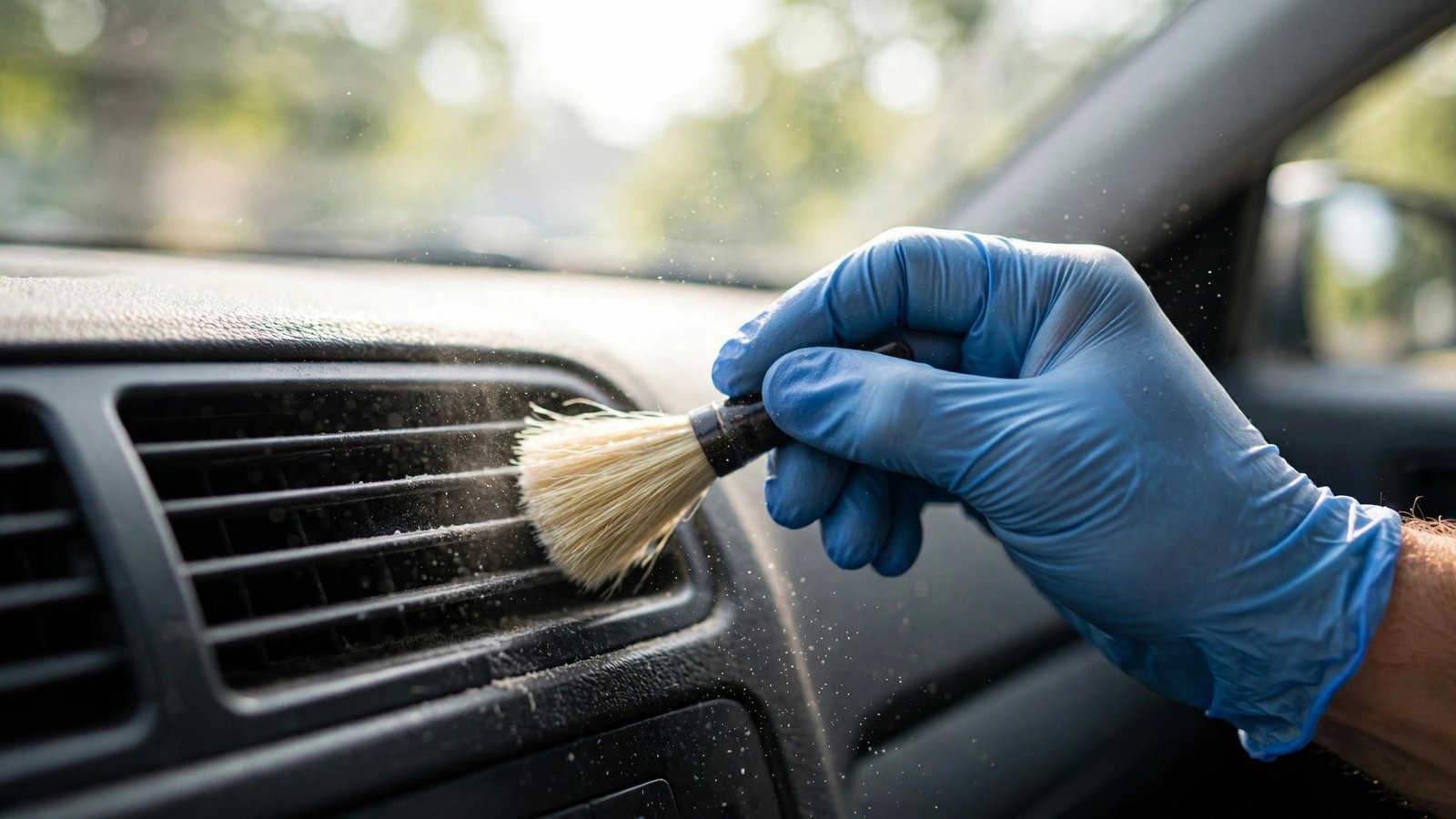
Empty the ashtray area, vacuum ash and crumbs from seams, wipe hard surfaces and wash removable mats. Both brands say, in their own way, to remove the odor source first. Treating a dirty car wastes product and guarantees the smell returns.
Work in the right order
Vacuum first, wipe second, check the cabin filter third, and only then run your chosen treatment. Park in the shade while a fogger runs, as its directions advise, and open every door afterwards so treated air can leave the cabin fully.
Follow the label, not a shortcut
For the Re-Fresher, that means an unoccupied car, recirculated air on high, doors closed for the full session, and a proper airing-out before anyone drives. For Ozium spray, it means short bursts, ventilation, and keeping the mist off painted surfaces, as its label directs.
Mistakes that undo good work
The common errors are spraying more instead of cleaning first, driving off before the car has aired out, leaving a new odor source — gym kit, food bags, wet towels — in the boot, and judging the result while fragrance is still at its strongest in the first hour.
One more Ozium vs Meguiars mistake is treating the two products as rivals for the same day. Used on the same afternoon, the fogger’s reset and a spray treatment overlap; used in sequence over weeks, they support each other.
If a treatment seems to have failed, ask what changed afterwards before blaming the product. In most Ozium vs Meguiars cases, a returning smell means a returning source.
Care, Maintenance and Reapplication
An odor treatment is not a one-day event; it is the start of a routine. This is where the Ozium vs Meguiars difference shows up most clearly in daily ownership, because one product is built for reapplication and the other is not.

Reapplying Ozium sensibly
Use the spray in short treatments when odor returns, rather than on a fixed schedule, and let the car air out briefly before driving. Replace the gel when it has dried out and shrunk, since a spent gel is no longer doing the quiet background job you bought it for.
Knowing when a second fogger session makes sense
A second Re-Fresher session is not a subscription — it is a repeat reset for a car whose odor was severe, or whose source was cleaned only after the first session. If a musty smell keeps returning, check the cabin filter and look for damp carpets before buying another can.
The maintenance habits that matter most
Change or inspect the cabin air filter as your car maker recommends, vacuum fabrics regularly, and keep smoking, food and wet gear from living in the car. These habits decide how long any Ozium vs Meguiars result lasts far more than the choice of can does.
Keep a simple rhythm: a quick tidy every week, a fabric vacuum every few weeks, and a treatment only when the cabin actually needs one. That rhythm prevents the slow build-up that turns a small smell into a weekend project.
Finally, store aerosol products as their labels direct — out of extreme heat and away from ignition sources — and never leave a used fogger can in a hot cabin. Safe storage is part of the routine, not an afterthought in any Ozium vs Meguiars plan.
Ozium vs Meguiars: Final Verdict
The honest verdict of this Ozium vs Meguiars comparison is that there is no single winner — there is a winner for your situation. Ozium takes the overall crown for smoke odor control because it is repeatable, fast, EPA-registered for the job, and cheap per treatment. It is the product you reach for week after week.
But Meguiar’s Whole Car Air Re-Fresher does something Ozium cannot: it pushes its odor-fighting mist through the entire ventilation system in one hands-off session. For a one-time reset — a used car, a post-detail refresh, smells hiding in the ductwork — it is the smarter single purchase. If you are shopping more broadly, our best car air fresheners guide covers the full field, from daily vent clips to heavy-duty odor killers.
Bottom-Line Verdict by Driver Type
If the sections above still leave you torn, here is the Ozium vs Meguiars bottom line, driver by driver.
Regular smoker: Ozium, as a spray for quick treatments or a gel for background control. Your problem repeats, so your product must repeat too.
Used-car buyer: The Meguiar’s Re-Fresher first, after a deep clean, to reset the vents and fabrics. Keep Ozium for the weeks that follow.
Rideshare and delivery drivers: The Ozium vs Meguiars answer is both, in sequence — a fogger reset between busy periods, and a light spray routine for daily freshness that passengers notice.
Families with kids and pets: Clean the source, use a fogger reset when the car is empty, air it out fully, and maintain with a gel kept out of reach — always following each label’s directions.
Occasional drivers: A gel or nothing may be enough. Save the fogger for a real odor event, and save the spray for the day a spill or a passenger changes the cabin.
Whichever type you are, the Ozium vs Meguiars winner is the product matched to your problem, used on a clean car, at the right time.
Frequently Asked Questions
Which is better for cigarette smoke, Ozium or Meguiar’s?
Ozium is the better choice for ongoing cigarette smoke control because its EPA-registered glycol formula is made for repeat smoke treatments and you can spray it as often as needed. Meguiar’s Re-Fresher is the better one-time treatment for smoke baked deep into the ventilation system, since its fogging mist flows through the ductwork.
Does Ozium really work, or does it just cover up smells?
Ozium is an air sanitizer, not a cover-up fragrance. Its glycol-ized formula (propylene glycol plus triethylene glycol) binds to odor-causing molecules and airborne bacteria, and its EPA-registered label claims both smoke removal and reduced airborne bacteria. It was originally developed for hospital and medical use.
How long does the Meguiar’s Re-Fresher treatment take?
The whole process takes about 30 minutes, most of it waiting. You place the can in the center of the car with the fan on high recirculated air and the doors closed for 15 minutes, then open all the doors and let the cabin air out for 10 to 15 minutes before driving. The car must be unoccupied during treatment.
Can I use Ozium and the Meguiar’s Re-Fresher together?
Yes, they complement each other well. Use the Re-Fresher first as the deep reset after cleaning — it handles odors inside the ventilation system. Then keep Ozium spray or gel on hand for weekly maintenance so smoke and other odors never build up again.
Is Ozium safe to use in a car with kids or pets?
Ozium spray should be used carefully around children and pets: avoid inhaling the mist, keep it off painted surfaces, do not store it above 130°F, and always air the car out briefly before driving. The gel format is lower-maintenance but should still be kept where children and pets cannot reach it.
Does Meguiar’s Re-Fresher really remove odors permanently?
Meguiar’s states that its Re-Fresher technology removes existing bad odors through chemical bonding at the molecular level — that is the manufacturer’s claim. In practice, one treatment handles moderate smoke, pet, and food odors well, but extreme cases like years of heavy smoking may need a second can plus a cabin air filter change, and the odor source must be cleaned first.
How often should I use Ozium in a car that is smoked in every day?
Use short spray treatments as odor returns — typically after smoky trips — and let the car air out briefly before driving. A gel can provide background control between sprays. There is no benefit in heavy, constant spraying; in the Ozium vs Meguiars routine, little and often beats a single drenching.
Why does a smell sometimes come back a few days after a treatment?
Usually because the source is still there: ash in seams, a spill under a seat, a loaded cabin filter or damp fabric. The treatment handled the air, not the cause. Clean the source, then repeat the treatment — that sequence is the core Ozium vs Meguiars lesson of this guide.
Should I check the cabin air filter before using either product?
Yes. A dirty cabin filter can hold dust and odor and push stale air back into the cabin every time the fan runs. Inspect it first, and replace it if it is clogged or smelly, so whichever product you choose is not fighting the ventilation system itself.
Can I keep an Ozium gel in the car and still use the spray?
Yes — they do different jobs. The gel gives slow, passive background control, while the spray handles sudden odor events. Keep the gel where children and pets cannot reach it, follow the spray label’s ventilation guidance, and avoid layering so much fragrance that the cabin becomes overwhelming.
Which is better for pet and food odors rather than smoke?
For a one-time whole-car problem after cleaning, the fogger’s whole-system reach is useful. For everyday pet and food smells that keep returning, the repeatable Ozium formats are easier to live with. That is the same Ozium vs Meguiars pattern as smoke: reset once, then maintain.
Will either product harm leather seats or interior trim?
Follow each label and you should not need to guess: keep Ozium spray off painted surfaces, avoid inhaling its mist, and air the car out before driving, as its label directs. The Re-Fresher is used in an empty car and aired out afterwards. If you are unsure about a delicate surface, keep direct spray away from it.