
This post contains affiliate links. As an Amazon Associate we earn from qualifying purchases.
Short answer: the best car air freshener for allergies is a fragrance-free odor absorber — like a bamboo charcoal bag or an unscented neutralizing sponge — rather than a scented freshener. Allergy and fragrance-sensitivity symptoms are usually triggered by the fragrance itself, so a product that removes odors without adding any scent solves the problem at its source instead of trading one irritant for another.
If scented car fresheners make you sneeze, give you itchy eyes, or trigger a headache on your commute, you are not imagining it. This guide explains what to look for, what to avoid, and compares four genuinely low-irritant options, based on manufacturer-published details and widely documented product characteristics. No lab testing, no invented scores — just an honest, research-based rundown of the best car air freshener for allergies you can buy.
Why Regular Car Air Fresheners Bother Allergy Sufferers
Most conventional car air fresheners work by filling a small, sealed cabin with synthetic fragrance. The word “fragrance” on an ingredient list can legally cover dozens of individual scent chemicals, and the exact formula is usually proprietary — so you rarely know precisely what you are breathing. For people with fragrance sensitivity, that cocktail is the problem: sneezing, watery or itchy eyes, a stuffy nose, and headaches are commonly reported reactions to strong artificial scents in enclosed spaces.
It is worth distinguishing two different issues. A true allergy is an immune response; fragrance sensitivity is an intolerance-style reaction. Both feel miserable in a car, and both are typically triggered by the scent chemicals rather than by the odor-absorbing base of the product. That is why the best car air freshener for allergies is rarely the strongest-smelling one on the shelf — strength of scent and likelihood of irritation tend to rise together.
One more honest note: if you have asthma, strong fragrances are widely listed among everyday airborne irritants. This guide is general information, not medical advice — if scents affect your breathing, check with your doctor about what to avoid in your car.
Fragrance-Free vs Unscented: What Actually Matters
These two labels sound alike but mean different things, and the difference matters for allergy sufferers. In common labeling usage, “fragrance-free” generally means no fragrance ingredients were added to the product at all. “Unscented,” on the other hand, can mean that masking fragrance was added to cover up a base smell — the product smells like nothing, but fragrance chemicals may still be present.
For anyone shopping for the best car air freshener for allergies, “fragrance-free” is the safer label to look for. “Unscented” is usually fine too — both of the sponge absorbers below are sold as unscented and contain no added perfume — but fragrance-free is the stricter standard. When in doubt, check the manufacturer’s own description rather than the front of the box.
Best Car Air Freshener for Allergies: 4 Fragrance-Free Picks
Every pick below adds little or no scent of its own. They are ordered by how completely they avoid fragrance chemicals, starting with the purest options. Each one is sold on Amazon, where you can read the manufacturer’s full description before buying.
1. PURGGO Car Air Freshener — Best Fragrance-Free Overall
PURGGO is a car air purifier made with 100% activated bamboo charcoal, and its product description states plainly that it contains no fragrance, no plastic, and no chemicals. The brand goes further than most: its own listing says the product is “great for people with allergies, asthma, stuffy nose, and other breathing sensitivities.” The porous bamboo charcoal works like a sponge, trapping odor particles as air passes through — it removes odor rather than covering it up, which is exactly what an allergy sufferer wants.
The brand also claims it lasts 365+ days, far longer than the roughly 45-day life it attributes to common scented fresheners, and says the charcoal can be reused as plant fertilizer at the end of its life. We have a full detailed breakdown of this one already — see our PURGGO car air freshener review for the details.
2. Bad Air Sponge Odor Absorber — Best Unscented Odor Neutralizer
Bad Air Sponge is sold as unscented — the product listing specifies “Scent: Unscented” — and the manufacturer describes it as an odor neutralant rather than a masking agent: it neutralizes odors on contact instead of covering them with perfume. That distinction is the whole reason it belongs on a best car air freshener for allergies list. It comes as a semi-solid gel in a 14-ounce tub that sits on a seat or the floor, passively working on background odors like food, smoke residue, and mustiness.
Because there is no fragrance to fade, it keeps working until the gel is used up, and there is nothing to trigger scent-sensitive passengers. Keep the tub upright and out of direct sun on the dashboard — like any gel, it softens in extreme heat.
3. Nature’s Air Sponge Odor Absorber — Best Unscented Gel Option
Nature’s Air Sponge is another unscented gel absorber — its listing also specifies “Scent: Unscented” — that works the same passive way: open the tub, place it in the car, and let it absorb odors from the air. It is a simpler, widely available alternative to Bad Air Sponge for drivers who want a set-and-forget background deodorizer with no perfume at all.
Gel absorbers like this one are especially useful in cars that pick up recurring mild odors — gym bags, takeout, a damp trunk — because they keep absorbing between drives instead of just perfuming the air for the first ten minutes. For how charcoal and gel absorbers compare generally, our activated charcoal bags for car odor guide covers the absorption approach in depth.
4. Moso Natural Air Purifying Bag (200g) — Best Charcoal Bag
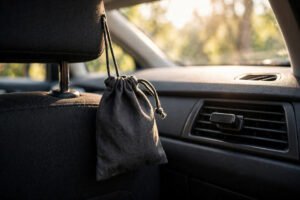
The Moso Natural bag is made from 100% bamboo charcoal and releases no fragrance — reviewers consistently note it as suitable for people sensitive to scents. It is the classic hang-it-and-forget-it option: loop it over a headrest or tuck it under a seat, and the charcoal steadily absorbs odors for up to about two years, with a monthly hour in direct sunlight to rejuvenate it (the standard care routine for charcoal bags, covered in our charcoal guide linked above).
Charcoal bags will not perfume your car — that is the point. If you want the cabin to smell like something, this is not the product. But if your goal is neutral, clean-smelling air with nothing added, a charcoal bag is the simplest answer on this list.
Quick Comparison: The Best Car Air Freshener for Allergies at a Glance
| Pick | Type | Scent status | Best for |
|---|---|---|---|
| PURGGO Car Air Freshener | Bamboo charcoal | Fragrance-free (brand states no fragrance, no chemicals) | Allergy and asthma-sensitive drivers wanting the purest option |
| Bad Air Sponge | Gel odor neutralant | Unscented (listing specifies Unscented) | Neutralizing stubborn background odors without perfume |
| Nature’s Air Sponge | Gel odor absorber | Unscented (listing specifies Unscented) | Simple set-and-forget background deodorizing |
| Moso Natural Bag (200g) | Bamboo charcoal bag | No added fragrance | Long-term, maintenance-light odor control |
What to Avoid If You Have Allergies
Knowing what to skip is as useful as knowing what to buy. If you react to scents, steer clear of strong synthetic-fragrance vent clips and hanging trees — in a small sealed cabin, their scent concentration is at its highest, which is the worst case for a sensitive nose. Be skeptical of “odor eliminator” sprays that are really just heavy perfume; eliminating odor and masking odor are different jobs, and only the first helps you.
Also read “unscented” labels with the distinction from earlier in mind: most unscented absorbers are genuinely fine, but if you are highly sensitive, fragrance-free is the stricter claim to demand. And skip anything whose ingredient list hides everything behind the single word “fragrance” with no further detail — that is where the unknown triggers live. For a deeper look at which product types raise the most health questions, see our guide to the best non-toxic car air freshener.
For Babies and Newborns
Babies react more strongly to scents than adults do — what smells mild to you can feel overwhelming to an infant in a small car cabin. Around newborns, the safest choice is no added fragrance at all: a fragrance-free charcoal bag absorbs odors without releasing anything into the air. Avoid essential oils and strong fragrances near babies, since concentrated scents can irritate tiny airways. If the car needs freshening before a ride, ventilate first — open the doors for a few minutes — and skip the spray. Keep the cabin air filter fresh and the interior clean and dust-free, because stale air bothers sensitive little noses more than any product can fix. When in doubt, choose unscented and let clean air do the work.
Frequently Asked Questions
Can a car air freshener cause allergy symptoms?
It can trigger allergy-like symptoms — sneezing, itchy or watery eyes, a stuffy nose, headaches — in people with fragrance sensitivity. The trigger is usually the synthetic fragrance chemicals, not the odor-absorbing base. Switching to a fragrance-free absorber removes the trigger while still handling the smell.
What is the best car air freshener for allergies if I also have asthma?
The same fragrance-free absorbers: bamboo charcoal bags and unscented neutralizing sponges add no scent chemicals to the air you breathe. PURGGO’s own product description specifically mentions allergies, asthma, and stuffy noses among its intended users. This is general information, not medical advice — ask your doctor what is safe for your specific condition.
Is fragrance-free the same as unscented?
Not exactly. Fragrance-free generally means no fragrance ingredients were added at all; unscented can mean masking fragrance was added to hide a base odor. Both are far gentler than scented products, but fragrance-free is the stricter standard for sensitive users.
Do charcoal bags really work without any scent?
Yes — that is their whole mechanism. Activated charcoal is extremely porous, so odor molecules get trapped on its surfaces as air passes through. There is nothing to smell because nothing is being released; the air simply carries fewer odor particles. Monthly sunlight recharges keep them working.
How often should I replace a fragrance-free car odor absorber?
It depends on the type. PURGGO’s brand claims 365+ days of use; charcoal bags like Moso’s are generally rated for up to about two years with monthly sun recharges; gel sponges last until the gel evaporates, typically a few months. Replace any absorber when odors start returning — that is the honest signal it is spent.
Are essential-oil car diffusers better for allergies?
Usually not. Essential oils are still fragrances — natural, but still scent chemicals your nose has to process, and some people react to them just as strongly as to synthetic scents. If your goal is avoiding reactions, a fragrance-free absorber beats any scented diffuser, natural or not.
Conclusion
The best car air freshener for allergies is not a freshener at all in the traditional sense — it is a fragrance-free odor absorber. Bamboo charcoal bags like PURGGO and Moso remove smells without adding anything to the air, and unscented gel neutralizers like Bad Air Sponge and Nature’s Air Sponge do the same for stubborn background odors. Pick the format that fits your car, avoid heavy synthetic fragrances and vague “fragrance” ingredient lists, and your commute gets noticeably easier to breathe through. Clean air should not come with side effects.