Our guides are based on research of product specifications, manufacturer information, and patterns in verified buyer reviews.
Baking Soda for Car Odor: Does It Actually Work?
White, cheap, and sitting in millions of kitchens, baking soda has a reputation as the all-purpose odor fix. The question for drivers is specific: does the trick translate to a closed car cabin? This baking soda car odor guide tests the idea honestly — how it actually works, the six methods with the best results, and where this pantry staple falls short.
Baking soda is the most-recommended first step for food-related smells, which is why it shows up early in our guide to getting milk smell out of a car. But it is not a magic powder, and the methods below are ranked by real-world results — the difference between a fresher cabin and a white-dust mess is mostly in the technique, not the box.
How Baking Soda Neutralizes Odors
Baking soda is sodium bicarbonate, a mild alkali. Many common car odors — sour milk, sweat, food spills, old smoke residue — are acidic, and an alkali neutralizes acids on contact. It also absorbs some moisture from the air and from fabrics. That is the real chemistry behind baking soda car odor treatments: neutralize and absorb, not mask.
What it cannot do matters just as much. Baking soda does not kill mold, dissolve deep stains, or disinfect surfaces. It is a surface treatment for surface odors — very good within that lane, useless outside it. Keep that boundary in mind and the methods below will deliver instead of disappoint.
Which smells respond best? Fresh food odors, sweat, and general mustiness respond well because they are surface-level and acidic. A baking soda car odor treatment works on the smell molecules themselves, so the effect is genuine rather than borrowed time — but it fades fast if the source is still active, such as a slow leak keeping a carpet damp. Fix the cause first, then treat the smell.
Baking Soda Car Odor: 6 Methods That Work
Ranked from most to least effective for a typical cabin. Every method assumes you vacuum the area first — powder on top of grit just makes mud. A large box is cheaper per use than small shaker bottles if you plan the full treatment. .
One prep step comes first: remove every loose item, shake out the mats, and vacuum slowly. A baking soda car odor treatment laid over crumbs and grit cannot reach the fabric where odors actually live, and powder wasted on debris never neutralizes anything. Five minutes of prep doubles the value of the wait that follows.
Method 1: Sprinkle Seats and Carpets, Leave Overnight
The cornerstone of any baking soda car odor routine. Pull the floor mats out, vacuum everything thoroughly, then sprinkle a generous, even layer over fabric seats and carpet — about what fits in two handfuls per seat. Work it in lightly with a soft brush, close the car, and leave it for several hours at minimum; overnight works best. The next day, brush again and vacuum slowly, twice. This one treatment clears most mild-to-moderate general cabin odors.
Method 2: The Open-Box Trick for Ongoing Smells
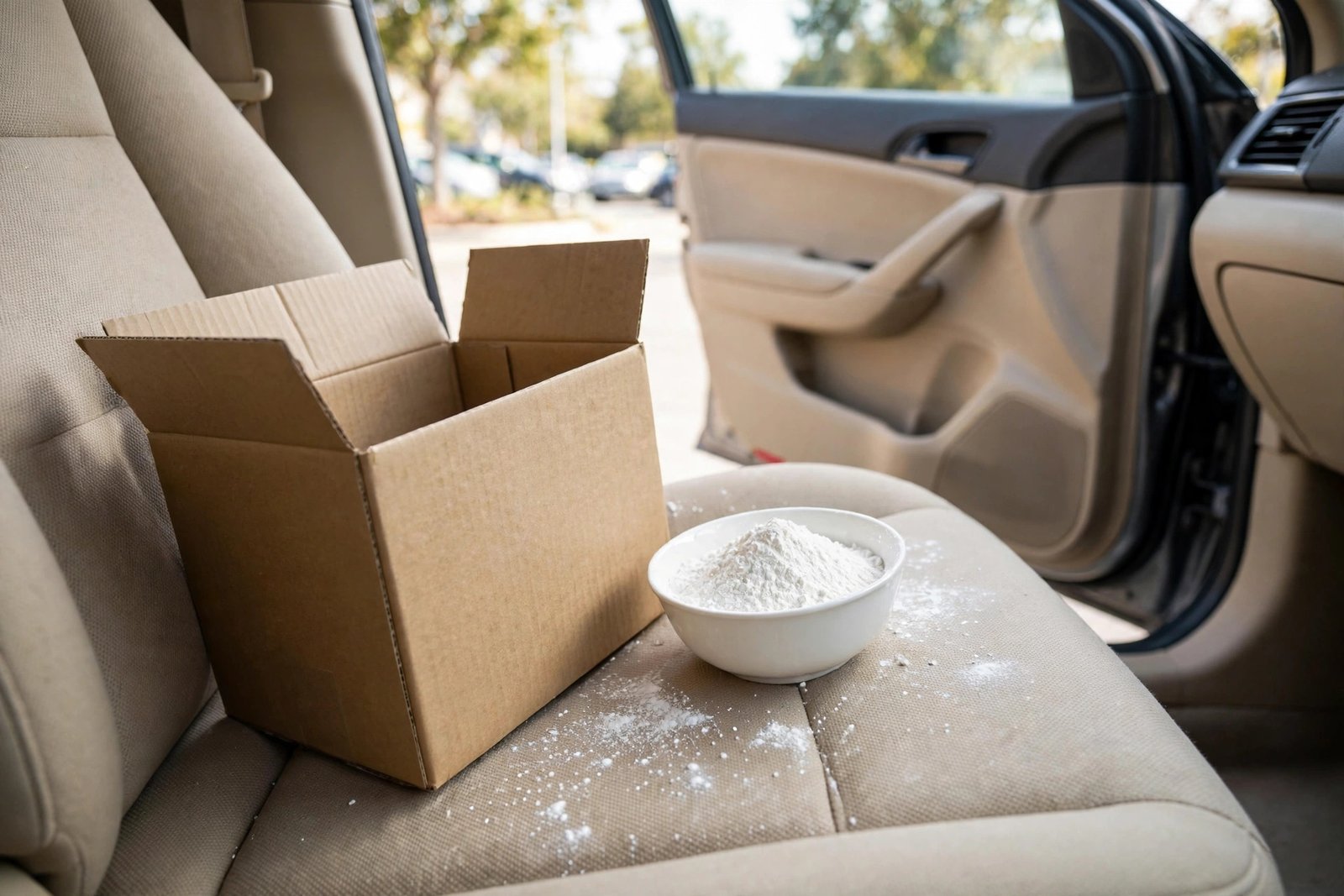
For a mild, lingering background smell, set an open box or a shallow bowl of baking soda on the floor behind the driver seat and leave it there. It quietly absorbs ambient odors for weeks; swap the powder monthly since it saturates. This is maintenance, not rescue — it does little against a strong smell, but it keeps an already-decent cabin smelling neutral between deep treatments.
Method 3: Baking Soda Paste for Hard Plastics
Mix baking soda with a little water into a thin paste and rub it gently on vinyl and hard-plastic trim — the center console, door pulls, cup-holder rims — where body oils and food residue collect. Wipe clean with a damp cloth. Test on a hidden spot first, and keep the paste off leather and suede entirely, where it can dry and abrade the finish.
Method 4: Trunk and Spare-Tire-Well Refresh
Trunks trap moisture and rubber smell, and the spare-tire well is a forgotten odor source. Empty the trunk, vacuum, sprinkle baking soda generously over the carpet and into the well, and close the lid for a few hours. Vacuum it all back out. Drivers are often surprised how much of their “car smell” was actually coming from the back.
Method 5: Floor-Mat Deep Treatment
Remove the mats and treat them outside the car: sprinkle both sides of fabric mats, leave overnight, then brush and shake out before vacuuming. Rubber mats should be washed with soap and water separately instead — powder on rubber just clumps. Footwells take the heaviest daily beating from shoes and sweat, so mats are worth treating on their own schedule.
Method 6: Boost With Sunlight and Ventilation
After vacuuming up the powder, park in direct sun with the windows cracked an inch or two (where safe to do so) for half a day. Heat speeds evaporation and UV helps with surface microbes on upholstery — this is less a baking soda car odor trick than the finish every treatment needs. Ventilation is the unsung half of every odor fix.
Whichever method you start with, give the powder time. Every baking soda car odor method on this list underperforms when rushed — contact time is, in effect, the active ingredient.
Which Method Fits Your Problem
| Method | Time Needed | Effort | Best For |
|---|---|---|---|
| Sprinkle & vacuum | Overnight | Medium | General cabin odors on seats and carpets |
| Open box | Ongoing | Very low | Mild lingering background smells |
| Paste scrub | 30 minutes | Low | Hard plastics, cup holders, trim |
| Trunk refresh | A few hours | Low | Stale trunk and spare-tire well |
| Floor-mat treatment | Overnight | Medium | Footwell sweat and dirt buildup |
| Sun + ventilation | Half a day | Very low | Finishing any treatment |
Where Baking Soda Falls Short
Honest limits first: powder is not a substitute for removing the source. The EPA’s guidance on indoor air follows the same priority order — it lists air fresheners among the sources of volatile organic compounds and puts source removal and ventilation first (EPA guidance on VOCs and indoor air). Baking soda fits that approach because it removes odor compounds — but only the ones it can actually reach.
Deep spills live below that reach. Sour milk soaked into seat foam, or a protein-based spill, sits where powder never touches; our guide on getting vomit smell out of a car covers the extraction-style cleaning those jobs need. Active mold is also out of scope — if the smell survives a full treatment and keeps growing back, treat the moisture problem, not the odor.
Where a single treatment ends, long-duration absorption begins. Activated charcoal keeps pulling odor molecules from cabin air for months at a time, which makes it the natural second step after a baking soda reset; our activated charcoal bags for car odor guide explains how they work. .
What NOT to Do
Do not mix baking soda and vinegar together on upholstery — the most common mistake in baking soda car odor advice. The acid and alkali neutralize each other on contact; the dramatic fizz is the two cleaners cancelling out. Use them separately, in sequence, if you want both effects. Do not use baking soda on leather or suede at all, and do not sprinkle it near vents or electronics, where loose powder can be blown deep into the system.
Do not leave the powder in place where it will get wet — a damp patch sets into a hard paste that is far harder to remove than the original spill. And keep children and pets off treated seats until you have vacuumed thoroughly, so loose powder is not tracked through the car or ingested.
Frequently Asked Questions
Does baking soda really absorb odors, or just mask them?
It genuinely neutralizes rather than masks. As sodium bicarbonate, it reacts with the acidic molecules behind many smells — sour milk, sweat, food spills — and absorbs some moisture. Its limits are real, though: it works on surface odors and does nothing against mold growth, deep stains, or years of embedded smoke.
How long should I leave baking soda in my car?
For a sprinkle treatment on seats and carpets, several hours is the minimum and overnight is better — contact time does the work. Vacuuming too early wastes the method. An open box left in a footwell can stay for weeks of gentle absorption, but swap the powder monthly as it saturates.
Will baking soda damage my car’s upholstery?
On fabric seats and carpets it is safe when vacuumed out thoroughly afterward. Keep it off leather and suede, where the dry powder can abrade and dry out the finish, and test any paste on a hidden spot first. Avoid getting treated areas wet before vacuuming, or the powder sets into paste.
Baking soda or activated charcoal — which is better for car odor?
They do different jobs. Baking soda is an active, one-time treatment that neutralizes acidic surface odors while it sits in contact with fabric. Activated charcoal is passive and long-lasting, adsorbing odor molecules from the air for months. Many drivers use baking soda first for a reset, then charcoal to keep the cabin neutral.
Can I mix baking soda and vinegar to clean car seats?
Not at the same time. The acid and alkali react on contact and neutralize each other, leaving mostly water and salt — the fizz looks productive but cancels both cleaners. If you want both effects, use them in sequence with a rinse between. On delicate fabrics, skip vinegar anyway; it can leave watermarks.
Does baking soda remove cigarette smoke smell from a car?
It helps with light, recent smoke smell sitting on surfaces, and an overnight sprinkle treatment is worth trying first. Years of embedded smoke in foam, fabric, and the headliner are beyond it, though — that needs deep cleaning, a fresh cabin filter, and ongoing charcoal absorption rather than a single powder treatment.
The Bottom Line
The honest verdict on baking soda car odor treatments: they work, within clear limits, for almost no cost. Sprinkle, wait, vacuum — that routine handles most everyday cabin smells, and the open-box trick maintains the result. Use the overnight sprinkle as your benchmark — it is the baking soda car odor test that tells you whether a smell is a powder problem or a cleaning problem. For smells soaked deep into foam or years in the making, treat baking soda as step one and move to deep cleaning and charcoal next. Once the cabin is genuinely neutral, a mild freshener adds scent without a cover-up job to do — see our best car air freshener picks for the options worth considering.


6 Comments