

How to Make Your Car Smell Good Without Air Fresheners
Short answer: if you want to know how to make car smell good without air freshener, clean first and mask nothing. Remove trash and vacuum every surface, sprinkle baking soda on dry upholstery overnight, place activated charcoal bags under the seats, air the cabin out fully, clean the AC vents, and replace the cabin air filter. The 12 fixes below go from a five-minute tidy to a full odor reset — no hanging tree required.
If you have been wondering how to make car smell good without air freshener, you are asking the right question. Air fresheners do not remove odors — they layer fragrance over them. The smell underneath is still there, and it returns the moment the fragrance fades. The real fix is removing the odor at its source, which is exactly what this guide walks you through.
This approach pairs well with our complete car odor eliminator guide, which covers the heavy-duty products for stubborn cases. Here, we stay product-light: cleaning, absorption, and airflow do the work. Our guides are based on research of product specifications, manufacturer information, and patterns in verified buyer reviews.
Fair warning: this takes a little more effort than clipping a freshener to a vent. But the payoff is a cabin that smells like nothing — clean, neutral, fresh — instead of a cabin that smells like “pine” fighting a losing battle against old gym socks. Even activated charcoal bags, the closest thing to a set-and-forget option, work best after the sources are handled.
Why Cleaning Beats Masking Every Time
Odors in a car come from physical things: spilled coffee in the carpet, crumbs fermenting under the seats, mildew on the AC evaporator, a cabin filter that has been trapping dust for three years. Fragrance molecules do not destroy those things. They compete with them in your nose, which is why a masked car smells fine for an hour and terrible by the weekend. That contrast is the heart of how to make car smell good without air freshener.
Absorbers are different. Baking soda and activated charcoal physically pull odor molecules out of the air and fabric. Ventilation and filter replacement physically remove the contaminated air and the dirty filter. That subtraction-first principle is the whole idea behind how to make car smell good without air freshener — and it is why every method below is ranked by how much odor it removes, not how nice it smells.
6 Natural Methods Compared
Here is how the main approaches stack up before we get into the step-by-step fixes. The best plan for how to make car smell good without air freshener usually combines one absorber with one airflow fix:
| Method | Cost level | Removes odor or just masks it? | Adds fragrance? | Best for |
|---|---|---|---|---|
| Baking soda | Very low | Removes (absorbs from fabric) | No | Upholstery and carpet smells |
| Activated charcoal bags | Low | Removes (adsorbs from air) | No | Ongoing, fragrance-free control |
| White vinegar wipe-down | Very low | Removes (cleans surfaces) | Slight, fades as it dries | Hard surfaces, cupholders, door panels |
| Coffee grounds | Very low | Mostly masks | Yes, coffee scent | Quick temporary cover-up |
| Essential-oil diffuser | Medium | Masks | Yes, your choice | Light ongoing scent without synthetics |
| Cabin filter replacement | Low–medium | Removes (at the source) | No | Musty AC and stale-air smells |
How to Make Car Smell Good Without Air Freshener: The 12 Fixes
Work through these in order — the first fixes solve most cases on their own, and the later ones handle stubborn sources:
- Remove all trash and clutter — food wrappers, old cups, and forgotten bags are the number-one smell source.
- Vacuum everything — seats, carpets, crevices, and the trunk. Most “mystery” smells are crumbs.
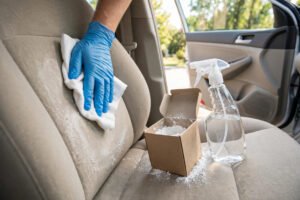
- Baking soda on dry upholstery — sprinkle generously, leave overnight, vacuum thoroughly.
- Vinegar wipe-down — diluted white vinegar on hard surfaces; the vinegar smell fades as it dries.
- Charcoal bags under the seats — fragrance-free ongoing absorption, recharged monthly in sunlight.
- Full air-out — open all doors and windows for 20–30 minutes on a dry day.
- Clean the AC vents — wipe vent slats and run the fan on fresh-air mode to flush stale air.
- Replace the cabin air filter — a clogged filter recirculates its own trapped dust and mildew.
- Enzyme cleaner on organic stains — for milk, food, or pet messes that keep re-smelling.
- Coffee grounds in a breathable bag — a temporary pleasant cover while deeper fixes work.
- Citrus peels for a day — orange or lemon peels in a cup give a short-lived fresh note; discard before they mold.
- USB essential-oil diffuser — light, natural scent for the long term without synthetic fragrance.
Fixes 1–2: Deep-Clean the Real Smell Sources
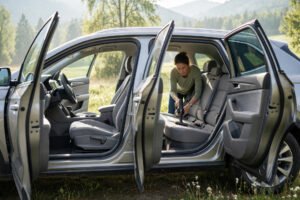
Learning how to make car smell good without air freshener starts with the least glamorous step: taking everything out. Pull the floor mats, empty every door pocket and cupholder, check under and between the seats, and clear the trunk. You would be surprised how often the “weird smell” turns out to be a six-week-old protein bar wrapper.
Then vacuum like you mean it. Use a crevice tool along seat rails, under the seats, and around the trunk edges — that is where crumbs and spilled drinks collect and quietly ferment. For fabric seats and carpet, a slow pass beats a fast one: let the suction do the work. If a specific stain keeps re-smelling days after cleaning, enzyme cleaners work on tough organic stains by breaking down the proteins and fats that regular soap leaves behind.
Fix 3: Baking Soda for Upholstery Odors
Baking soda (sodium bicarbonate) is the classic answer to how to make car smell good without air freshener on a budget. It is a mild alkali that absorbs odor molecules from fabric rather than covering them, and it is non-toxic in normal household use — which is why it has lived in refrigerators for decades.
The method: make sure the upholstery is dry, sprinkle a generous layer over seats and carpet, and leave it for at least a few hours — overnight is better. Then vacuum it all up thoroughly, going slowly so you lift the powder out of the fibers. That slow pass is a small but essential part of how to make car smell good without air freshener. One round handles everyday staleness; repeat it once for heavier odors like smoke residue. Do not use it on wet fabric — damp baking soda cakes into fibers and becomes its own cleanup job.
Fix 4: Activated Charcoal Bags for Ongoing Control
For day-to-day odor control with zero added fragrance, activated charcoal is the strongest natural option for how to make car smell good without air freshener over the long term. Its porous structure traps odor molecules from the air as it circulates — adsorption, not perfume. Tuck one or two bags under the front seats where air moves freely.
Quality varies. The well-known bamboo charcoal pouches are marketed to last up to a year with about an hour of monthly sunlight to recharge them, and the better ones use a breathable natural-fiber pouch with no added fragrance or chemicals. Generic bags work too, but most suggest monthly sunlight recharges and replacement every month or two — check whatever product you buy rather than assuming. Checking the recharge schedule is part of how to make car smell good without air freshener over the long term.
Check Price on Amazon
Fixes 5–6: Ventilate and De-Must Your AC Vents
Stale air is a smell of its own, and flushing it out is one of the first things to do when learning how to make car smell good without air freshener. On a dry day, open every door and window for 20–30 minutes and let the cabin fully exchange its air. Do this with the car off and parked safely — you are flushing out trapped humidity and the volatile compounds that fabrics release in heat, not just “letting fresh air in.”
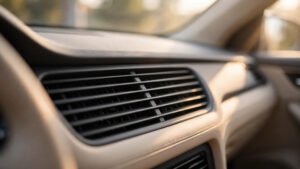
Then address the vents themselves. Wipe each vent slat with a damp microfiber cloth, then run the fan on high in fresh-air mode (not recirculate) for several minutes to push stale air out of the ducts. If you get a musty smell when the AC runs, the evaporator core is likely growing mildew — that needs a dedicated AC cleaning treatment, because no amount of cabin fragrance will fix a moldy evaporator. A clean evaporator is non-negotiable in how to make car smell good without air freshener.
Fix 7: Replace the Cabin Air Filter
The cabin air filter is the forgotten fix in most advice about how to make car smell good without air freshener. It traps dust, pollen, and moisture from incoming air — and after a year or more, the filter itself becomes a smell source, recirculating everything it caught. If your car smells stale no matter what you clean, the filter is a prime suspect.
Most automakers recommend replacement roughly once a year or every 12,000–15,000 miles — check your owner’s manual for the exact interval. On many cars it sits behind the glove box and swaps out in minutes with no tools. It costs less than a year of hanging fresheners and actually removes a smell source instead of arguing with it. That is the simple economics of how to make car smell good without air freshener.
Fixes 8–11: Natural Scent Boosters (No Fake Perfume)
Once the odor sources are gone, you might still want a pleasant note in the air — without synthetic fragrance. These boosters add scent rather than removing odor, so use them as the finishing touch to how to make car smell good without air freshener, not the fix. That honesty matters: if your car still smells bad after the first seven fixes, go back and find the source instead of reaching for these.
For organic messes that survived the deep clean — spilled milk, food, pet accidents — an enzyme cleaner is worth one targeted application. These products are marketed to break down the proteins, starches, and fats in organic stains, which is exactly the residue that keeps re-smelling on warm days. Apply per the label, let it dwell, and blot — do not drench the seat. Used carefully, enzyme cleaner earns its place in how to make car smell good without air freshener.
Coffee grounds in a breathable bag under the seat are a popular folk method; they mostly mask rather than remove, but the scent is natural and pleasant for a few days. Citrus peels work similarly for about a day — orange or lemon peels in an open cup give a fresh note, but discard them before they mold and become a new smell source. Both are temporary by design. Treat them as finishing touches in how to make car smell good without air freshener, never as the main fix.
For ongoing light scent, a small USB essential-oil diffuser gives you control over both strength and scent — citrus, peppermint, or eucalyptus are popular choices. Use it sparingly: a little goes a long way in a small cabin, strong scents can be distracting while driving, and some oils are irritating to pets, so skip the diffuser on trips with animals aboard.
Check Price on Amazon
What NOT to Do: 4 Mistakes That Make Smells Worse
Mistake 1: Running an ozone generator in an occupied car. Ozone generators are sometimes sold as odor killers, but the EPA cautions that ozone can irritate the lungs, and air-quality authorities warn against using them in occupied spaces. Read the EPA’s page on ozone generators sold as air cleaners before you even consider one. Ventilation and cleaning are safer and more effective. They are also the foundation of how to make car smell good without air freshener.
Mistake 2: Stacking fresheners on top of a dirty cabin. Three hanging fresheners do not triple the freshness — they triple the chemical load in air you breathe for hours. If you are sensitive to synthetic fragrance, that cocktail is also worth avoiding for health concerns around synthetic fragrance alone.
Mistake 3: Sealing a damp car. Spilled a drink or left windows open in rain? Dry it fully — towels, then airflow, then sun. A sealed damp cabin grows mildew in days, and mildew is a far worse smell problem than whatever you started with.
Mistake 4: Overdoing essential oils. More drops do not mean more freshness; they mean headaches on long drives. Start with the diffuser’s lowest setting and add slowly. Your nose adapts within minutes, but your passengers’ noses will not thank you for a eucalyptus fog.
Frequently Asked Questions
Does baking soda really remove car odors?
Yes — baking soda is one of the simplest ways to start learning how to make car smell good without air freshener. It absorbs odor molecules from dry fabric rather than masking them. Sprinkle it on seats and carpet, leave it overnight, and vacuum thoroughly. It handles everyday staleness well, though heavy smoke or mildew may need a second round.
How long should I leave baking soda in my car?
A minimum of a few hours, but overnight gives the best results because the powder needs contact time to absorb odors from the fibers. Make sure the upholstery is completely dry first — damp baking soda cakes into fabric and becomes difficult to vacuum out. Always vacuum slowly afterward to lift all the powder.
Do activated charcoal bags actually work in cars?
They work as ongoing, fragrance-free odor absorbers, not instant fixes. The porous charcoal traps odor molecules from circulating air. Place bags under the seats where air moves, recharge them in direct sunlight about monthly, and replace them per the product’s guidance. They perform best after you have cleaned the actual smell sources first.
Why does my car still smell bad after cleaning?
Because the source is somewhere you have not cleaned yet. Common culprits: the cabin air filter, mildew on the AC evaporator, spills soaked into seat foam, or the trunk and spare-tire well. Figuring out how to make car smell good without air freshener means finding the source first — fragrance only hides it temporarily.
Are essential oil diffusers safe to use in a car?
Generally yes when used sparingly, with two cautions for anyone exploring how to make car smell good without air freshener this way. Strong scents can be distracting on long drives, so start at the lowest setting. And some essential oils irritate pets — skip the diffuser when animals ride along. A small USB diffuser with a water reservoir is the most practical car option.
How often should I replace my cabin air filter to prevent smells?
Roughly once a year or every 12,000–15,000 miles, though your owner’s manual has the exact interval. If your car smells stale or musty despite cleaning, a clogged filter is a likely culprit since it recirculates trapped dust and moisture. On many cars it swaps out behind the glove box in minutes.
The Bottom Line
Now you know how to make car smell good without air freshener: remove the sources, absorb what is left, and keep air moving. Trash out, vacuum thoroughly, baking soda overnight, charcoal bags for maintenance, a fresh cabin filter, and clean vents will beat any fragrance product — because there is no odor left to argue with.
And if you ever do want a little fragrance on top of a genuinely clean cabin, our best car air freshener guide covers the options worth your money. Clean first, scent second — in that order, every time.


One Comment