Short answer: If you want to know how to get sweat smell out of car seats and carpet, start here: vacuum first, then treat the fabric with baking soda, let it sit for several hours, and vacuum again. For smell that has soaked in, follow with a vinegar-and-water spray or an enzymatic cleaner, then dry the seats and carpet completely. Air fresheners only cover the smell — the odor stays until the sweat residue is removed from the fabric.
Why sweat smell sticks to car seats and carpet
Sweat itself is mostly water and salt, but when it soaks into fabric seats and carpet, moisture gets trapped in the fibers. In a warm, closed car, that dampness lingers, and odor-causing bacteria grow in it. That is why the smell often gets worse on hot days, and why a spray of air freshener fades within hours — the scent sits on top while the residue underneath stays put.
Cloth seats and carpet hold sweat far more than leather or vinyl, because the fibers absorb it. Leather seats can still smell where sweat transfers to stitching and perforations, but the fix there is wiping, not deep cleaning fabric. Learning how to get sweat smell out of car seats and carpet starts with this: the odor lives in the fibers, not in the air — so the fix has to reach the fibers too. This guide covers cloth seats and carpet, which is where sweat smell is hardest to remove.
What you need
- A vacuum with a hose or upholstery attachment
- Baking soda (plain, from the kitchen)
- White vinegar and a spray bottle
- Clean white cloths or old towels
- An enzymatic cleaner, for smell that has soaked deep into the fabric
- Optional: a portable carpet and upholstery cleaner, if the smell has been there a long time
Step 1: Remove the source and air the car out
Before cleaning anything, take out whatever is holding the smell. Gym bags, damp towels, sweaty clothes, and seat covers that have absorbed sweat should come out of the car. Wash gym bags and towels at home — leaving them in the car overnight, even once, is enough to restart the smell after you clean.
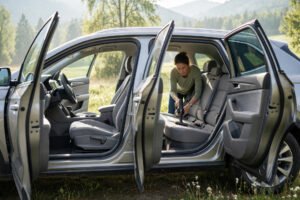
Then open all the doors for a few minutes and let fresh air move through the cabin. This does not remove the smell on its own, but cleaning a closed, stuffy car traps moisture, and drying matters as much as cleaning in the steps below. Airing the car out is part of how to get sweat smell out of car seats and carpet without trapping moisture.
Step 2: Vacuum the seats and carpet thoroughly
Vacuum every seat, including the seams, seat backs, and the carpet under and around the seats. Sweat dries into a thin residue, and dried skin cells and dust sit in the same fibers — vacuuming removes the loose material so the cleaning steps reach the fabric instead of the dirt on top of it.
Use the crevice tool along seat seams and where the seat meets the backrest. If your car has floor mats, take them out and vacuum both sides, then clean them separately following the same steps. Vacuuming first is essential to how to get sweat smell out of car seats and carpet, because cleaning works on fabric, not on loose dirt.
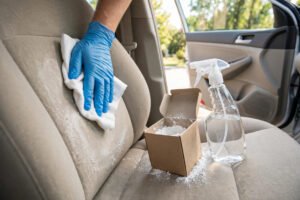
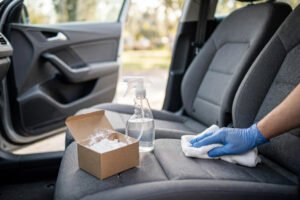
Step 3: Baking soda treatment (the first real step)
Baking soda is the standard first treatment for sweat smell in car fabric, and it is the method our baking soda for car odor guide covers in detail. It works by absorbing odor from the fibers rather than covering it.
- Make sure the seats and carpet are dry before you start.
- Sprinkle a generous, even layer of baking soda over the smelly areas — seats, carpet, and floor mats.
- Work it lightly into the fabric with a soft brush or your hand so it reaches the fibers.
- Leave it for at least 4 to 6 hours. Overnight is better for a strong smell.
- Vacuum it all up, slowly, in two passes.
For a mild smell — a few gym trips, a hot week — this step alone often solves it. If the smell is still there after vacuuming, move to the next step instead of repeating baking soda. A second round helps only if the first round clearly reduced the smell.
Step 4: Vinegar-and-water spray for light, lingering odor
If a faint smell remains after the baking soda treatment, a diluted vinegar spray can help. Mix equal parts white vinegar and water in a spray bottle. Lightly mist the smelly area — damp, not soaked — and let it sit for 15 to 20 minutes, then blot with a clean cloth. This spray is one part of how to get sweat smell out of car seats and carpet when the smell is faint.
Test first: spray a small amount on a hidden spot, such as the underside of a seat, and check after a few minutes that the fabric color and texture look unchanged before treating the visible areas. Vinegar smell fades as it dries, which usually takes an hour or two with the windows open. Do not use vinegar on leather, and do not soak the fabric — wet seats that stay damp can develop a musty smell of their own.
Step 5: Enzyme cleaner for sweat smell that has soaked in
When sweat has soaked deep into a seat or carpet — months of gym trips, a rideshare car, a seat that was sweated on daily — baking soda and vinegar may only reduce the smell. The next step for how to get sweat smell out of car seats and carpet is an enzymatic cleaner, which breaks down the organic residue that causes the odor instead of masking it.
Spray the enzymatic cleaner evenly over the affected area, enough to dampen the fibers, and leave it for the time stated on the bottle’s label. Then blot with a clean cloth and let the area dry completely. Do not rinse it off unless the label says to, and do not mix it with other cleaners.
One option is Nature’s Miracle Advanced Stain and Odor Eliminator Dog Spray, 32 oz. It is sold as an enzymatic formula for tough organic messes — the same kind of odor-causing residue that builds up when sweat soaks into fabric. It is a spray, so it is easy to apply to a seat or carpet section, and it works on fabric and carpet. Use it only on the areas that smell, follow the label instructions, and test a hidden spot first.
Pros: targets the residue that causes the smell rather than covering it; spray format suits seats and carpet; works on fabric and carpet. Cons: needs time to sit and dry, so it is not a five-minute fix; a very old, deep smell may need a second application; it is sold for pet messes, so check the label for your fabric type before use.
Step 6: Deep extraction for a smell that will not move
If the smell survives baking soda, vinegar, and an enzyme cleaner, it is deep in the foam or the carpet backing, and surface treatments cannot reach it. At that point, extraction is the honest next step: hot water and suction pull the residue out of the fibers. Extraction is the deepest step in how to get sweat smell out of car seats and carpet.
A portable carpet and upholstery cleaner does this at home. The BISSELL Little Green Multi-Purpose Portable Carpet and Upholstery Cleaner, 1400B is a compact machine made for carpets and upholstery, including car seats and car carpet. It sprays cleaning solution and vacuums it back out, which is the part that matters — wiping only moves residue around, while extraction removes it. Use the upholstery tool on seats and the wider tool on carpet, work in small sections, and make a second suction-only pass over each section to pull out as much moisture as possible.
Pros: reaches residue that sprays and powders cannot; suits both seats and carpet; useful for other car messes afterward, such as coffee or food spills. Cons: a machine is a bigger purchase than a spray or a box of baking soda; the seats need hours to dry afterward; if you only need it once, renting a carpet cleaner or hiring a detailer for a single deep clean may cost less.
If you do not want to buy a machine, a professional interior detail with hot-water extraction does the same job. Ask for upholstery extraction specifically — a basic wash and vacuum does not reach deep odor.
Step 7: Dry everything completely
This step decides whether the smell stays gone. Wet fabric that dries slowly in a closed car can grow a musty smell on top of the sweat smell, which leaves you with two problems. Drying is the last step in how to get sweat smell out of car seats and carpet, and it matters as much as cleaning.
After any wet treatment, leave the windows open or the doors ajar for several hours, ideally in sunlight with air moving through the cabin. If the weather does not allow that, run the car’s heater with the fan on high and the windows cracked. Press a dry towel into the seats and carpet — if it comes away damp, the fabric is not dry yet. Do not put floor mats back, close the car up, or cover the seats until everything feels dry to the touch.
Step 8: Keep a charcoal bag in the car afterward
Once the seats and carpet are clean and dry, a passive absorber helps keep the smell from coming back between cleanings. It does not clean anything — it absorbs odor from the air over days and weeks. A charcoal bag is maintenance after learning how to get sweat smell out of car seats and carpet, not a cleaner.
The Moso Natural Air Purifying Bag 200g is a linen bag of bamboo charcoal. The manufacturer states it covers up to 90 square feet and can be reused for up to two years by placing it in direct sunlight about once a month. It has no scent of its own, so the car smells neutral rather than perfumed, and it suits drivers who are sensitive to strong fragrances. Hang it from a headrest or set it on a seat — but remember it is maintenance, not a cure. If sweat soaks into the seats again, the bag will not fix that; cleaning will.
Pros: no scent added, so nothing to clash with; reusable for up to two years with monthly sunlight, per the manufacturer; works passively in the background. Cons: works slowly, over days, so it cannot fix a car that already smells; a large car or a severe smell may need more than one bag; it absorbs odor but does not remove residue from fabric.
What does not work
It helps to know what does not work before spending money on it. When you are figuring out how to get sweat smell out of car seats and carpet, these are the dead ends:
- Strong air fresheners and vent clips. A heavy fragrance layered over sweat smell usually makes the combination worse, and the smell returns as soon as the fragrance fades. Fresheners are for a clean car, not a smelly one.
- Spraying perfume or body spray on the seats. Same problem, plus it can stain fabric.
- Leaving the windows down for a day and hoping. Ventilation helps drying, but it does not remove residue from fibers.
- Cleaning only the surface. Wiping the top of a seat while the foam underneath still holds sweat leaves the smell in place.
How to keep sweat smell from coming back
Most of the work in how to get sweat smell out of car seats and carpet for good is habit, not products. Our best car odor eliminator guide covers the gym-bag routine in more detail; the short version is:
- Take gym gear out of the car the same day. Never leave a damp towel or sweaty clothes in the car overnight.
- Sit on a washable towel for the drive home from the gym, and wash it after each use.
- Wipe down hard surfaces — steering wheel, door handles, gear shift — where sweat transfers.
- Wash gym bags regularly instead of letting them live in the trunk.
- After a sweaty drive, open the doors for a few minutes before locking up, so moisture does not sit in the cabin overnight.
For rideshare and taxi drivers, the same routine matters more, because a new passenger every few minutes notices smell immediately. Our best car air freshener for Uber drivers guide covers keeping a shared car fresh between trips; the cleaning steps above are the foundation under it.
Frequently asked questions
How long does it take to get sweat smell out of a car?
A mild smell often improves the same day with vacuuming and a baking soda treatment left for several hours. A smell that has soaked in over weeks or months usually takes two rounds — baking soda first, then an enzyme cleaner or extraction — and a full day of drying. The full process for how to get sweat smell out of car seats and carpet takes longer than a spray, but it is the part that actually removes the residue. If the smell is still strong after two proper treatments, the residue is likely deep in the foam or carpet backing, and extraction is the next step.
Can I use baking soda on leather seats?
Baking soda is for fabric seats and carpet. On leather, wipe the seats with a damp cloth and a leather cleaner made for car interiors, then dry them. Do not sprinkle baking soda on leather and leave it, and do not soak leather seats with vinegar solution.
Does vinegar damage car upholstery?
Diluted white vinegar is generally used on fabric seats and carpet, but always test a hidden spot first and use it lightly — damp, not soaked. Do not use it on leather, suede, or Alcantara, and do not use it on a fabric you have not tested. If the label on your seats warns against cleaners, follow the label.
Why does the sweat smell come back after cleaning?
The most common reason is that the seats or carpet were not fully dry before the car was closed up, which lets a musty smell grow. The second most common reason is that the source is still in the car — a gym bag, a damp towel, or a seat cover that was never washed. The third is that the smell was deeper than the treatment reached, which is when extraction is needed.
Will an air freshener fix sweat smell in my car?
No. An air freshener adds scent on top of the odor; it does not remove the sweat residue from the fabric. Once the fragrance fades, the smell is still there. Clean first, then use a freshener — or a charcoal bag — to keep a clean car smelling neutral. Our best natural car air freshener guide lists lighter-scent options for a car that is already clean. Clean first — that is how to get sweat smell out of car seats and carpet for good.
As an Amazon Associate I earn from qualifying purchases.